
Beyond the Notes: Why Creativity Matters in Music Teaching
Bringing Music to Life
Learning music is often associated with notes, rhythm, technique, and practice. All of these are essential, but some of the most meaningful learning happens when a teacher finds a way to make those concepts come alive. Music, after all, is much more than a collection of black dots and mysterious symbols on a page. It can march, whisper, dance, sparkle, race, float, surprise us, and tell a story without saying a single word. This is where creativity becomes such an important—and joyful—part of music education.
When Words Aren’t Enough
For children especially, musical language can be surprisingly abstract. Instructions such as “play more expressively,” “make the sound lighter,” “relax your hand,” or “shape the phrase” may be perfectly clear to an experienced musician, but they do not always create an immediate picture in a young student’s mind. Even familiar musical terms such as legato, staccato, crescendo, and tempo can remain simply words until a child has truly experienced what they mean. A creative teacher finds ways to connect these musical ideas with something children already know, recognize, and understand.
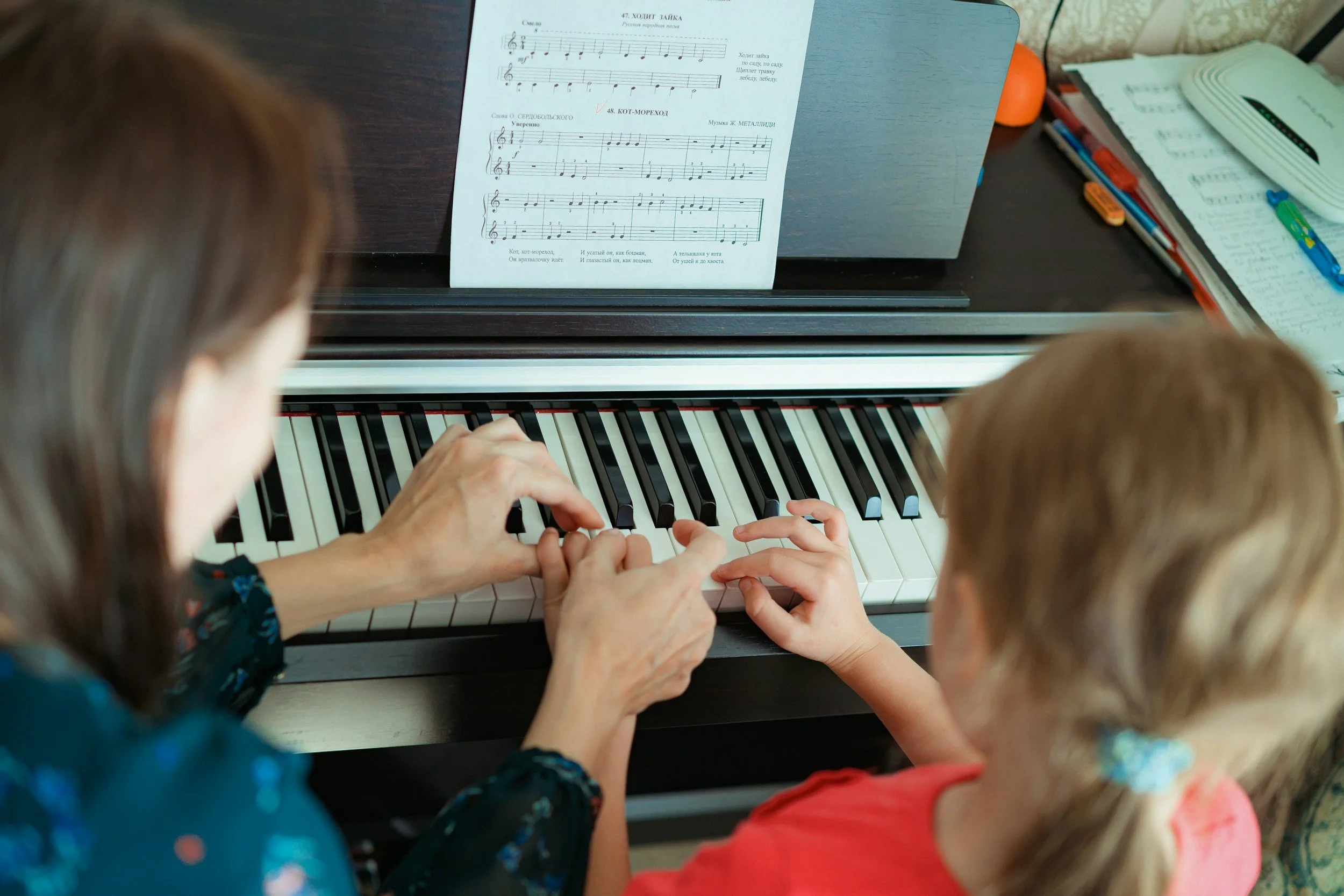
This is where imagination can work a little magic. A melody can float like a feather, a crescendo can grow like an ocean wave, a light passage can tiptoe like a mouse, and a flowing phrase can move like a ribbon dancing through the air. A powerful section might sound like giant footsteps coming down the hallway, while a delicate passage might sparkle like tiny stars. A quick staccato might become popcorn bouncing in a pan. Suddenly, an idea that was difficult to explain becomes something a child can picture, feel, and eventually translate into sound.
The Power of Metaphor
The playful images are not simply there to make a lesson entertaining. Beneath all the feathers, waves, mice, giants, and popcorn, some very real musical learning is taking place. Dynamics become more meaningful when students can imagine sound growing, approaching, disappearing, or moving farther away. Articulation becomes clearer when they can picture the difference between bouncing, gliding, marching, or tiptoeing. Phrasing begins to make sense when a melody has somewhere to travel rather than being treated as a row of individual notes waiting to be played.
In this way, metaphor gives an invisible art form a more tangible shape. We cannot hold a musical phrase in our hands or watch a crescendo grow in front of us, yet musicians constantly speak about shape, color, weight, direction, and movement. We describe sounds as warm or bright, melodies as soaring, rhythms as driving, and phrases as breathing. Creative teaching allows children to enter this imaginative musical language naturally, long before they are ready to analyze every detail intellectually.
Movement can open another door. Music almost asks us to move, and children rarely need much encouragement to answer. A steady beat can become marching feet. A flowing melody can travel through sweeping arm movements. A slow tempo might become the walk of a sleepy bear, while a quick one might turn into a tiny mouse hurrying across the room. A crescendo can begin with the child curled up very small and end with arms stretched as wide as possible. Before a single note is played on an instrument, the music has already been felt.
This connection between music and the body is especially important for young learners because playing an instrument is a physical experience. It requires coordination, balance, control, freedom of movement, and an awareness of how the body feels. Telling a child to “relax” may not always produce much of a result. Asking them to imagine that their arm has suddenly turned into a heavy elephant trunk may create an entirely different response—and perhaps a smile along the way. The goal is still a healthy technique, but the road toward it feels much more natural.
Storytelling offers yet another way into music. A piece does not need an official story printed underneath the title for a child to discover one. A quiet opening might become the entrance to a mysterious forest. A sudden loud chord could be thunder, a castle door slamming shut, or a dragon making an unexpected appearance. A fast middle section might turn into a chase, and when the opening melody finally returns, perhaps our imaginary traveler has found the way home.
Through these stories, children begin noticing musical details almost without realizing it. Why did the music suddenly become louder? Why did it speed up? Why did the mood change? Why does this melody sound familiar? Has it been here before? The story invites children to listen for repetition, contrast, tension, surprise, and return. Musical structure begins to emerge not as a dry concept to memorize, but as something they can hear and follow. And listening is at the heart of creative music education. Young students can easily become absorbed in the mechanics of playing: finding the correct note, using the correct finger, counting the right number of beats, remembering the accidental, and somehow reaching the final bar without a musical disaster along the way. Those skills certainly matter, but when all the attention goes toward correctness, the child can forget the most important thing of all: to listen.
Creative questions bring the ears back into the lesson. Does this phrase sound peaceful or excited? Does it feel as though it is going somewhere or settling down? Is this melody sneaking, dancing, floating, or marching? Does the second phrase want to sound exactly like the first? If this section were a character, who would it be? There is suddenly much more to notice than whether the correct finger landed on the correct note.
This approach is especially valuable because every child learns differently. Some children immediately respond to pictures and visual images, while others understand something through movement, stories, sound, or physical experience. One student may happily spend an entire lesson imagining musical animals, while another may prefer rockets, superheroes, colors, sports, fairy tales, weather, or trains. There is rarely only one doorway into a musical idea. The same rhythm might be clapped, walked, spoken, bounced, or imagined as the sound of a train moving along the tracks. A musical phrase might be sung, drawn as a line, turned into a story, or traced through the air. A difficult passage could become a challenge for a superhero, a race that must remain controlled, or a secret message that needs to be whispered rather than shouted. The musical goal stays the same, but the route toward understanding can change completely.
That flexibility becomes particularly important when a student is struggling. Every teacher knows the moment when an instruction has been repeated several times and the result somehow remains exactly the same. “Relax your hand.” Again. “Try not to rush.” Again. “Make it lighter.” Again. At some point, repeating the same words is unlikely to unlock the problem.
A creative teacher changes the language. Perhaps the child needs to see the idea, move it, hear an exaggerated contrast, imagine a character, or connect it to something familiar. Sometimes one unexpected comparison produces the little look teachers love to see—the expression that says, Oh! Now I get it.
The role of a creative music teacher, then, goes far beyond making lessons fun. It is about making musical ideas understandable, memorable, and meaningful. It is about recognizing that children do not all learn in the same way and being willing to find different paths toward understanding. It is about combining strong musical foundations with imagination and giving children permission to be curious about sound. Because sometimes the most memorable music lessons begin not with the instruction, “Play it this way,” but with a question that opens an entirely different door: “What do you imagine?”
Start Your Musical Journey
Learning an instrument gives children a stronger brain, a creative outlet, and skills that last a lifetime. Stage Music Center is proud to guide students at every step of their musical path.
Begin music lessons today in Winchester or Acton.
Ready to embark on this exhilarating musical adventure? Take the first step, sign up for music lessons at Stage Music Center today. Or contact us for more information about our music classes.
The school offers a variety of music lessons to the residents of Acton and Winchester, MA, in addition to catering to areas like Stoneham, Woburn, Arlington, Medford, Lexington, Carlisle, Concord, Westford, and Littleton. Stage Music Center provides students with the opportunity to explore their musical passions and develop their talents.
Learn more about our music lessons.
Register online or contact us for more information.